When science communicators spread misinformation
In response to Levent Alpöge’s Claude-assisted Lean certificate showing the Riemann Hypothesis is true, many people have had doubts about the validity of the certificate. This has not been helped by influential science communicators spreading misinformation. One example is Angela Collier, a well-known astrophysicist and science communicator, who posted the following:
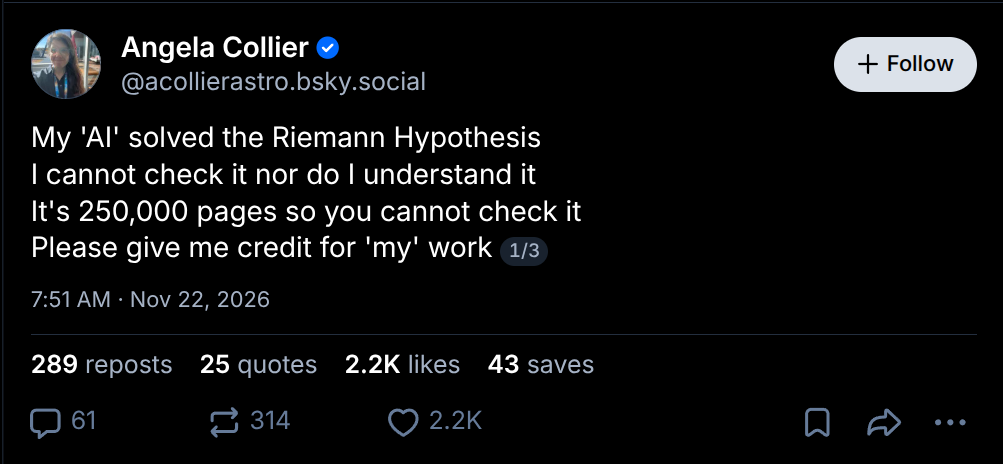
Most charitably, this can be described as a kind of satire. But the satire only works if “you cannot check it” is true. It is not. It is understandable when ordinary people don’t get the power of formal systems, but science communicators not getting it and then telling others about it like this is inexcusable.
Historically, mathematics has been based on the idea that the validity of a statement and its understanding are tightly coupled. The purpose of a formal system like Lean is to decouple the two things. More specifically, if you are confident in both of the statements below:
- Your formal system — the theoretical framework — is sound. This means that it is guaranteed that all statements it accepts are true, assuming that its axioms are true. (By Gödel’s first incompleteness theorem, there are true statements that the formal system will reject, but that is acceptable.)
- Your implementation of the theoretical framework is correct. (No checker can verify itself, so there will always be a minimal part that cannot be machine-checked. This is called the trusted computing base or TCB.)
Then, it necessarily follows that any string of symbols accepted by your implementation of the formal system is true. This is regardless of whether anyone understands it. The Lean community has done a fantastic job with both of these properties. Particularly impressive is the second property, which they’ve managed by building several different checker implementations (kernels). It is vanishingly unlikely that any string of symbols, no matter how adversarial, will be able to exploit bugs in all of them.
To repeat, since this isn’t clear enough to many people, the power of formal systems is that you do not have to understand statements they accept to know that they are true. I know this can sound a little bit absurd, but it is true. Formal systems enable this kind of one-level-removed abstraction.
To summarize:
It is reasonable to say that we don’t have a full proof of the Riemann Hypothesis yet. Simon Farnsworth, a former coworker of mine, put it well: there is a helpful distinction to be drawn between something humans can directly comprehend — what one of his professors called a proof — and something a machine can verify — a certificate. (Why? Because understanding a proof generates new ideas, and opens new avenues for exploration, in a way that a machine-checked certificate does not. The work to understand the Riemann Hypothesis certificate is ongoing.)
It is reasonable to dislike the focus on results over understanding. In my own field I’ve repeatedly stressed the importance of understanding what you’re doing when you use LLMs, on air and in writing.
It is false to say that “you cannot check it”. You can check it. Many people have checked it. The claimed 250,000-page PDF is not load-bearing in any sense. You only have to believe statements 1 and 2 above, and to make sure the Lean program proves the right thing (it does, and in particular only uses the standard axioms) and that it compiles (you can download it from GitHub).
Science communicators have a very basic duty of care not to spread misinformation.