<?xml version="1.0" encoding="utf-8"?><feed xmlns="http://www.w3.org/2005/Atom" xml:lang="en-us"><generator uri="https://gohugo.io/" version="0.170.0">Hugo</generator><title type="html">Vcs on sunshowers</title><subtitle type="html">thoughts and ideas</subtitle><link href="https://sunshowers.io/tags/vcs/" rel="alternate" type="text/html" title="html"/><link href="https://sunshowers.io/tags/vcs/index.xml" rel="alternate" type="application/rss+xml" title="rss"/><link href="https://sunshowers.io/tags/vcs/atom.xml" rel="self" type="application/atom+xml" title="atom"/><updated>2026-11-15T23:03:09+00:00</updated><rights>© Rain 2020-present. Licensed under CC BY-NC-SA 4.0 unless marked otherwise.</rights><author><name>Rain</name></author><id>https://sunshowers.io/tags/vcs/</id><entry><title type="html">More on Anthropic's Scion ripping off Mononoke</title><link href="https://sunshowers.io/posts/anthropic-mononoke-2/?utm_source=atom_feed" rel="alternate" type="text/html"/><link href="https://sunshowers.io/posts/anthropic-mononoke/?utm_source=atom_feed" rel="related" type="text/html" title="Anthropic's Scion is heavily inspired by Mononoke"/><link href="https://sunshowers.io/posts/transition-metaphysics/?utm_source=atom_feed" rel="related" type="text/html" title="I didn't transition for the metaphysics"/><link href="https://sunshowers.io/posts/there-is-no-free-will/?utm_source=atom_feed" rel="related" type="text/html" title="Free will quite clearly doesn't exist"/><link href="https://sunshowers.io/posts/be-an-adult/?utm_source=atom_feed" rel="related" type="text/html" title="Professionals demonstrate empathy"/><link href="https://sunshowers.io/posts/tmp-cleaner/?utm_source=atom_feed" rel="related" type="text/html" title="Dealing with tempfile cleaners"/><id>https://sunshowers.io/posts/anthropic-mononoke-2/</id><published>2026-10-15T00:00:00+00:00</published><updated>2026-10-15T00:00:00+00:00</updated><content type="html"><![CDATA[<blockquote>Answering questions and concerns.</blockquote><p><em>Update: Nick G. from Anthropic has <a href="https://news.ycombinator.com/item?id=50107559">responded on Hacker News</a>, and <a href="https://www.anthropic.com/engineering/redesigning-source-control#footnote-2">sufficient attribution</a> has been added to Anthropic&rsquo;s blog post. I stand by my posts as of the time I wrote them.</em></p>
<hr>
<p><em>Discuss on <a href="https://news.ycombinator.com/item?id=50106738">Hacker News</a>.</em></p>
<p>In response to <a href="/posts/anthropic-mononoke/">yesterday&rsquo;s post</a> about Anthropic&rsquo;s Scion ripping off Mononoke, I received a number of questions and concerns. Here&rsquo;s a followup to answer the big ones.</p>
<p><strong>This was a ripoff.</strong> My post yesterday was trying to be as charitable as possible given what I knew, and in particular that the similarity to Mononoke was mostly unintentional and the lack of credit was the result of not doing due diligence. However, after publishing the post I privately received confirmation that Scion intentionally and blatantly ripped off Mononoke, and in particular that there was overlap in personnel. There is no chance that this was an unintentional homage. This is something I had a hunch about but was not comfortable saying yesterday, given what I knew back then.</p>
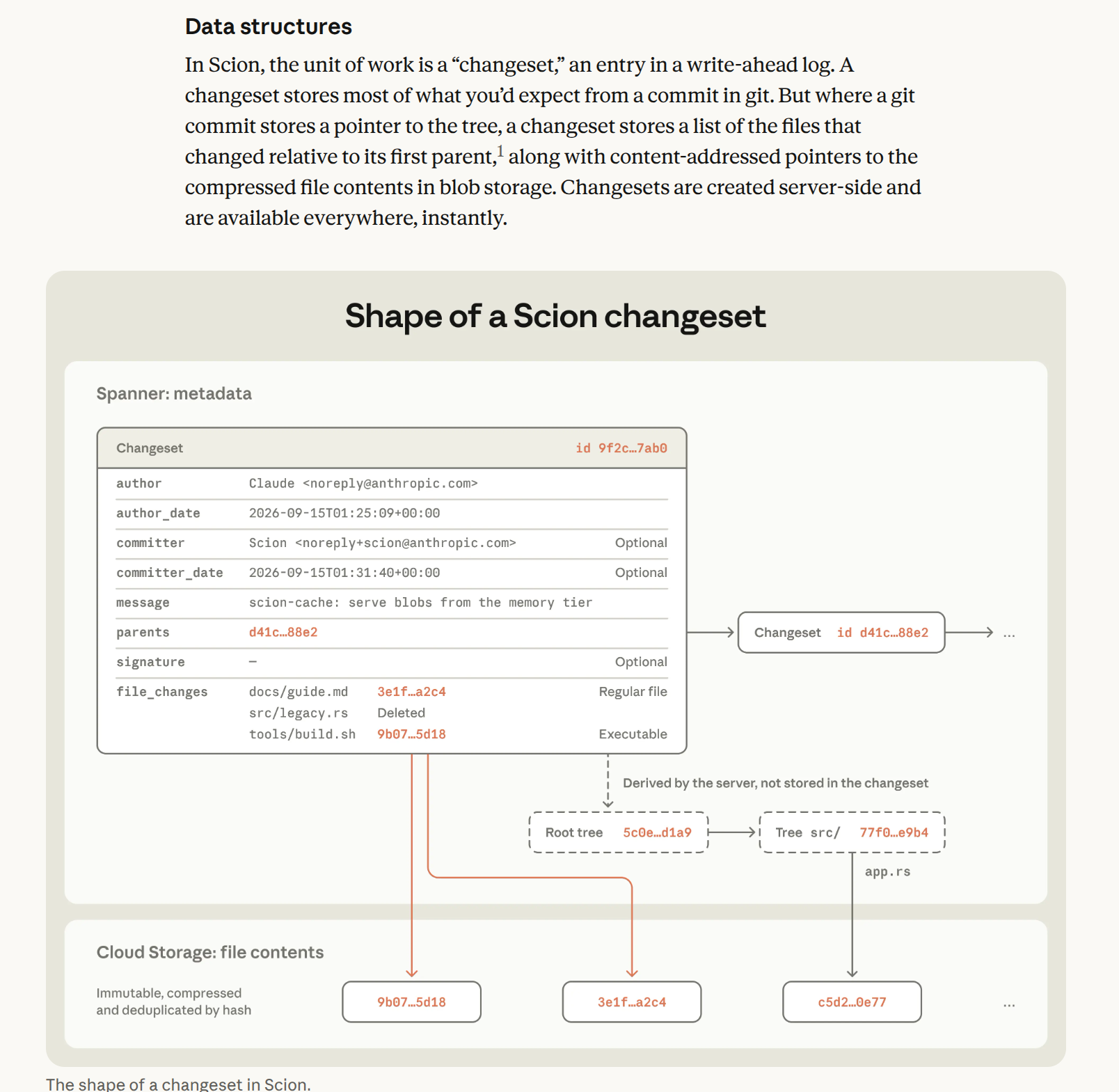
<p><strong>The resemblance is much deeper than just the notion of derived data.</strong> Some people pointed out that derived data is just an index, which is a well-known concept. I want to clarify that derived data was merely the most striking resemblance. It goes much deeper than that, and extends to the <em>entire</em> data model, as well as a number of the structures built around it.</p>
<p>Here is how Anthropic describes Scion changesets:</p>

  <figure class="center" >
    
      <a href="/images/scion-changeset.png">
    
    <img src="/images/scion-changeset.png"  alt="In Scion, the unit of work is a “changeset,” an entry in a write-ahead log. A changeset stores most of what you’d expect from a commit in git. But where a git commit stores a pointer to the tree, a changeset stores a list of the files that changed relative to its first parent,1 along with content-addressed pointers to the compressed file contents in blob storage. Changesets are created server-side and are available everywhere, instantly. (followed by a pictorial of a changeset)"   />
    
      </a>
    
    
      <figcaption class="center" >How Anthropic describes Scion&rsquo;s changesets.</figcaption>
    
  </figure>


<p>Mononoke has the <em>same</em> concept; we call it a Bonsai changeset. In the same Oxide materials from 2022, here&rsquo;s how I described them:</p>

  <figure class="center" >
    
      <a href="/images/bonsai-changeset.png">
    
    <img src="/images/bonsai-changeset.png"  alt="The Bonsai data model. To solve this problem, we flipped around how we look at commits. Rather than containing a pointer to the root tree object, a Bonsai changeset contains the metadata (author, commit message etc), hashes of parents, plus the list of files changed in it and hashes of blobs. (A Bonsai changeset is still a Merkle DAG, just with a different model.)"   />
    
      </a>
    
    
      <figcaption class="center" >How I described Mononoke&rsquo;s Bonsai changesets.</figcaption>
    
  </figure>


<p>They are <em>exactly</em> the same. Even the name &ldquo;Scion&rdquo; reverses the syllables of &ldquo;Bonsai&rdquo; and drops the &ldquo;B&rdquo;! This might be a coincidence, or might not.</p>
<p>For derived data, I also wanted to draw attention to the <em>kinds</em> of indexes being built, such as for blame. Needing to do this is a natural consequence of the Bonsai data model, so it&rsquo;s not surprising that indexes need to be built; I was drawing attention to the striking similarity in terminology and framing, because that was indeed how we used to think about it during my time on Meta&rsquo;s source control team.</p>
<p>Another set of resemblances is in the server-side API to do version control queries and mutations with. This was implemented in Mononoke, but I believe other systems before Mononoke had it as well, so I&rsquo;m not going to claim novelty. But if what you did is point Claude at Mononoke and asked it to rebuild that, you would probably design something very similar.</p>
<p><strong>The Bonsai data model is wildly contrarian.</strong> I want to emphasize that the prevailing wisdom in source control is Git-like data models. Building a write-ahead log-style Merkle DAG was very far away from what anyone else was doing in 2018, and required solving several hard problems along the way such as how to perform server-side rebases (to my knowledge, one of several novel algorithms in Mononoke). While I was leading the team effort to design and implement the model in 2018, I personally had to justify it to several layers of management at Meta. It is quite rare for skip levels to get pulled in to discuss a system&rsquo;s data model in depth.</p>
<p><strong>The Bonsai data model is also wildly successful.</strong> At this point, almost a decade later, the model has been stretched far outside its initial design parameters, and it&rsquo;s still chugging along. The team effort to build it remains one of my proudest career achivements. Given the overlap in personnel, there is no reasonable way the Scion team could not have known about this. (Which is why they quite reasonably copied it!) This brings us to my next point:</p>
<p><strong>The problem is attribution, not copying.</strong> I mentioned this in my original post, but I am <em>completely</em> fine with good ideas being copied. I am not fine with the serial numbers being accidentally stripped off, and I am <em>certainly</em> not fine with them being intentionally stripped off.</p>
<p><strong>Crediting Sapling for &ldquo;hard-won lessons&rdquo; is not enough.</strong> Several people pointed out that Mononoke is part of the Sapling ecosystem. The problem here is that Sapling can mean either the VCS client (<code>sl</code>, originally forked from <code>hg</code>) or the system as a whole. If you were previously on Meta&rsquo;s source control team, you absolutely know the difference between the two. Besides, the resemblance is much, much deeper than merely &ldquo;hard-won lessons&rdquo;. The <a href="https://epicgames.github.io/lore/explanation/system-design/">Lore</a> VCS can claim inspiration from Mononoke, but it differs in several ways as well. Scion&rsquo;s resemblance to Mononoke goes well beyond that, and merely crediting Sapling (not even Mononoke) with &ldquo;hard-won lessons&rdquo; is dishonest. (And specifically, I would expect the Scion changeset section to mention Bonsai changesets as the thing they are copied from.)</p>
<p><strong>This makes Anthropic&rsquo;s achievement significantly less impressive.</strong> Anyone who&rsquo;s put a distributed system into production knows how many issues tend to crop up during the productionizing process. &ldquo;Our LLM built this thing, productionized it, and dealt with all the attendant challenges over 5 months&rdquo; is a significantly more compelling narrative than &ldquo;the source control team at Meta had spent 10 years building and productionizing this system, and we were able to point our LLM at it and rebuild it in 5 months&rdquo;.</p>
<p><strong>…and yet, it is still quite an achievement.</strong> Being able to point to an existing system and rebuild it in this short a period is still quite stunning. It is shocking to me that Anthropic didn&rsquo;t just say they copied Mononoke and rebuilt it in 5 months. That is still noteworthy, even if it isn&rsquo;t as grand. Surely they knew they would be called out?</p>
<p><strong>It is always good to situate your work in the larger context.</strong> We all stand on the shoulders of giants! There is nothing wrong with borrowing and adapting existing work to new contexts — that is the vast majority of what I do as an engineer. When you position your work as derivative, you are acknowledging those that came before you, as you hope to be acknowledged by those who come after you.</p>
<p><strong>There is nothing without the team.</strong> On a personal note, it&rsquo;s been many years since I worked on Mononoke. There is a team that still carries the torch forward all these years later, solving new and existing problems, including many I&rsquo;m sure are my fault. Anthropic ripping the Bonsai data model off hit me hard, but spare a thought for the team working on it now: those who were most directly plagiarized. Imagine how they must feel about their work being <em>deliberately</em> copied wholesale and <em>intentionally</em> presented as someone else&rsquo;s.</p>
<hr>
<p>It&rsquo;s been two days since I first posted about this on Bluesky and Linkedin, and I haven&rsquo;t seen an update to the original post yet. This remains yet another shameful example of large AI companies appropriating the commons and presenting others&rsquo; work as their own. I don&rsquo;t know what it will take to rebuild bridges from here, but my default assumption now is that Anthropic&rsquo;s public engineering presentations are largely bad-faith ripoffs. That&rsquo;s a shame.</p>
]]></content><category scheme="https://sunshowers.io/tags/vcs" term="vcs" label="vcs"/><category scheme="https://sunshowers.io/tags/shorts" term="shorts" label="shorts"/></entry><entry><title type="html">Anthropic's Scion is heavily inspired by Mononoke</title><link href="https://sunshowers.io/posts/anthropic-mononoke/?utm_source=atom_feed" rel="alternate" type="text/html"/><link href="https://sunshowers.io/posts/transition-metaphysics/?utm_source=atom_feed" rel="related" type="text/html" title="I didn't transition for the metaphysics"/><link href="https://sunshowers.io/posts/there-is-no-free-will/?utm_source=atom_feed" rel="related" type="text/html" title="Free will quite clearly doesn't exist"/><link href="https://sunshowers.io/posts/be-an-adult/?utm_source=atom_feed" rel="related" type="text/html" title="Professionals demonstrate empathy"/><link href="https://sunshowers.io/posts/tmp-cleaner/?utm_source=atom_feed" rel="related" type="text/html" title="Dealing with tempfile cleaners"/><id>https://sunshowers.io/posts/anthropic-mononoke/</id><published>2026-10-14T00:00:00+00:00</published><updated>2026-10-14T00:00:00+00:00</updated><content type="html"><![CDATA[<blockquote>It is important to provide credit.</blockquote><p><em>Update 2026-10-15: I wrote <a href="/posts/anthropic-mononoke-2/">a followup</a> to answer questions and concerns.</em></p>
<hr>
<p><em>Discuss on <a href="https://news.ycombinator.com/item?id=50094694">Hacker News</a> or <a href="https://lobste.rs/s/plcgps/anthropic_s_scion_is_heavily_inspired_by">Lobsters</a>.</em></p>
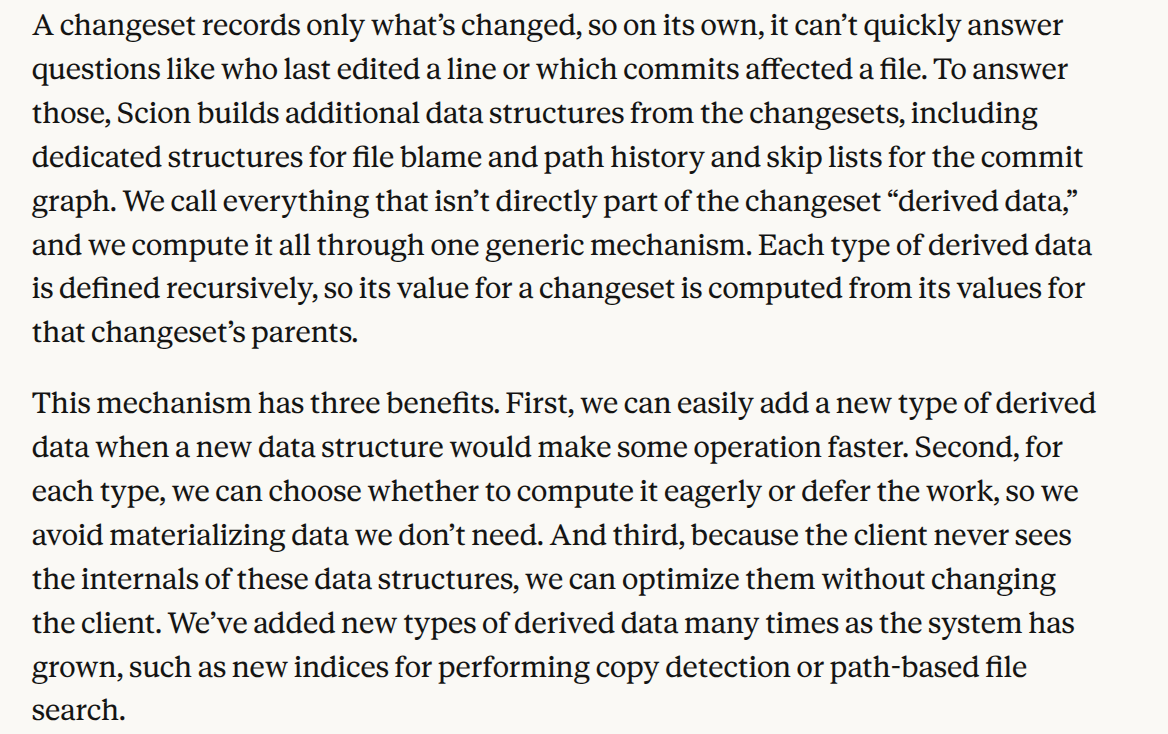
<p>Here is Anthropic <a href="https://www.anthropic.com/engineering/redesigning-source-control">describing</a> (<a href="https://ghostarchive.org/archive/hCFVA">archive link</a>) yesterday how their new version control system, Scion, uses a concept called &ldquo;derived data&rdquo; to make operations like blames more efficient:</p>

  <figure class="center" >
    
      <a href="/images/scion-derived-data.png">
    
    <img src="/images/scion-derived-data.png"  alt="A changeset records only what’s changed, so on its own, it can’t quickly answer questions like who last edited a line or which commits affected a file. To answer those, Scion builds additional data structures from the changesets, including dedicated structures for file blame and path history and skip lists for the commit graph. We call everything that isn’t directly part of the changeset “derived data,” and we compute it all through one generic mechanism. Each type of derived data is defined recursively, so its value for a changeset is computed from its values for that changeset’s parents. This mechanism has three benefits. First, we can easily add a new type of derived data when a new data structure would make some operation faster. Second, for each type, we can choose whether to compute it eagerly or defer the work, so we avoid materializing data we don’t need. And third, because the client never sees the internals of these data structures, we can optimize them without changing the client. We’ve added new types of derived data many times as the system has grown, such as new indices for performing copy detection or path-based file search."   />
    
      </a>
    
    
      <figcaption class="center" >How Anthropic describes Scion&rsquo;s derived data.</figcaption>
    
  </figure>


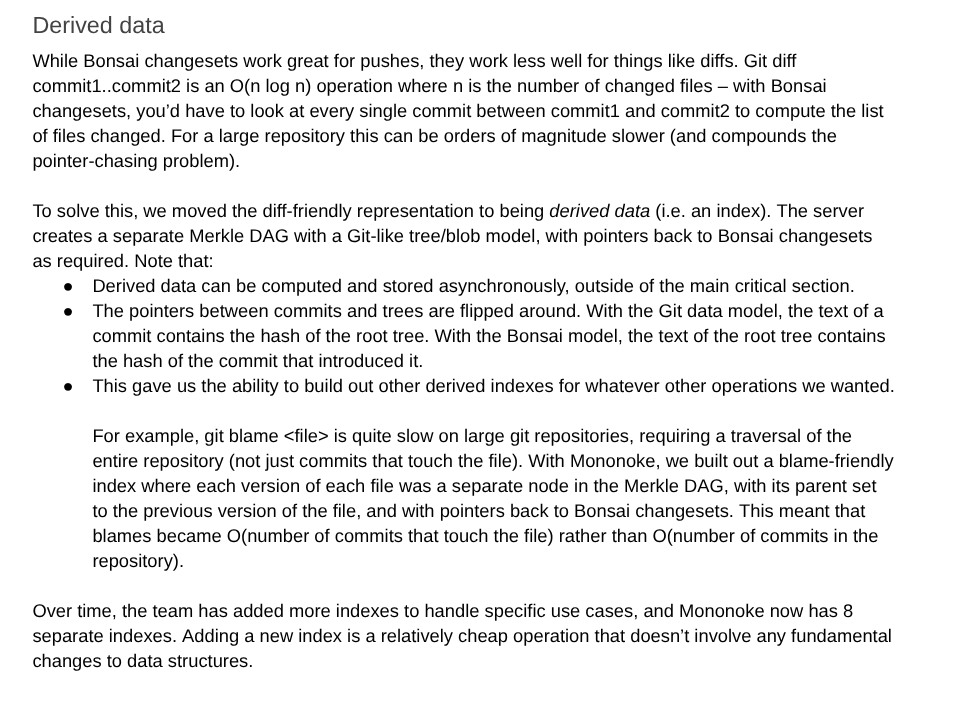
<p>Here is me, back in 2022, describing in my Oxide candidate materials how the <a href="https://github.com/facebook/sapling/tree/main/eden/mononoke">Mononoke</a> source control server I helped build uses a concept called &ldquo;derived data&rdquo; to make operations like blames more efficient:</p>

  <figure class="center" >
    
      <a href="/images/mononoke-derived-data.png">
    
    <img src="/images/mononoke-derived-data.png"  alt="Derived data. While Bonsai changesets work great for pushes, they work less well for things like diffs. Git diff commit1..commit2 is an O(n log n) operation where n is the number of changed files – with Bonsai changesets, you’d have to look at every single commit between commit1 and commit2 to compute the list of files changed. For a large repository this can be orders of magnitude slower (and compounds the pointer-chasing problem). To solve this, we moved the diff-friendly representation to being derived data (i.e. an index). The server creates a separate Merkle DAG with a Git-like tree/blob model, with pointers back to Bonsai changesets as required. Note that: Derived data can be computed and stored asynchronously, outside of the main critical section. The pointers between commits and trees are flipped around. With the Git data model, the text of a commit contains the hash of the root tree. With the Bonsai model, the text of the root tree contains the hash of the commit that introduced it. This gave us the ability to build out other derived indexes for whatever other operations we wanted. For example, git blame is quite slow on large git repositories, requiring a traversal of the entire repository (not just commits that touch the file). With Mononoke, we built out a blame-friendly index where each version of each file was a separate node in the Merkle DAG, with its parent set to the previous version of the file, and with pointers back to Bonsai changesets. This meant that blames became O(number of commits that touch the file) rather than O(number of commits in the repository). Over time, the team has added more indexes to handle specific use cases, and Mononoke now has 8 separate indexes. Adding a new index is a relatively cheap operation that doesn’t involve any fundamental changes to data structures."   />
    
      </a>
    
    
      <figcaption class="center" >How I described Mononoke&rsquo;s derived data.</figcaption>
    
  </figure>


<p>I think the level of imitation goes well beyond having similar insights<sup id="fnref:1"><a href="#fn:1" class="footnote-ref" role="doc-noteref">1</a></sup>. The fact that Sapling was only credited for &ldquo;hard-won lessons&rdquo;, and that Mononoke was not mentioned at all, borders on plagiarism. The post comes off as Anthropic claiming that Claude designed all this, while the reality is that our (extraordinary) team at Meta came up with many of the insights that Claude dutifully applied almost a decade later. (We looked at plenty of prior art for Mononoke and Sapling too, from Google&rsquo;s SrcFS to write-ahead logs in databases.)</p>
<p>I am very glad that the vision our team had back in 2017-18 was so powerful and enduring — when you go against the grain, you&rsquo;re always a bit unsure if what you&rsquo;re doing is genius or madness, and I think Mononoke&rsquo;s design has stood the test of time. And, to be clear, I do not have a problem with Anthropic copying Mononoke&rsquo;s design. (This is part of why we put out open source — to benefit humanity through the spread of good ideas.)</p>
<p>But as LLMs continue to assist in designing new systems, they are likely to index heavily on existing designs. Mononoke is <a href="https://github.com/facebook/sapling/tree/main/eden/mononoke">open source</a> and in every LLM&rsquo;s training set. If you ask <a href="https://claude.ai/share/e6a66ec5-7757-4adb-901f-0e33b1c38536">Opus 5.5</a> or <a href="https://chatgpt.com/share/6ace7be6-68f8-83ea-ad68-0f9d14448318">GPT-6 Astra</a> (thanks <a href="https://bsky.app/profile/jauntywunderkind.bsky.social/post/3mxsettjnoc22">Matthew Fowle</a>) about prior art, they both immediately point out the similarities to Mononoke.</p>
<p>Giving credit to those that came before us is now easier — and more important — than ever. There is no longer an excuse.</p>
<div class="footnotes" role="doc-endnotes">
<hr>
<ol>
<li id="fn:1">
<p>For an example of a system with similar insights but many key design differences, see <a href="https://cursor.com/blog/git-at-any-scale">Vicent Marti&rsquo;s blog post for Cursor</a>.&#160;<a href="#fnref:1" class="footnote-backref" role="doc-backlink">&#x21a9;&#xfe0e;</a></p>
</li>
</ol>
</div>
]]></content><category scheme="https://sunshowers.io/tags/vcs" term="vcs" label="vcs"/><category scheme="https://sunshowers.io/tags/shorts" term="shorts" label="shorts"/></entry></feed>